Day 8 of the 26 Day Big Shut Up: resistance is futile and other silencing tactics.

No No No No No No No.

No No No No No No No.

No No No No No No No.

No No No No No No No.
No No No No No No O..

K, go on then.

This blog is contributing to The Mighty (Un)Mute, a campaign aiming to raise £5,000 to support the artistic creation for one of ten Globe Sculptures in The World Reimagined art trail across Leicester. The purpose? To recognise and honour those most impacted by the Transatlantic Trade in Enslaved Africans through the centuries to the present day.

The TMC staff team are going to support the campaign by taking part in the Mighty (UN)Mute, a day-long vow of silence, on the 5th October. If you want to join us on the day and take a vow of silence, then please check out the campaign here. 

Of if the thought of donating your silence for 24 hours is really too much, then you can donate your hard-earned disposable income here.

Or if neither of these is possible (and heaven knows we’re all in tough financial times right now), then anything you can do to share and shout about the campaign would be equally welcome and appreciated.

So… come and help me to shut up, once and for all. You know you want to.

Day 7 of the 26 Day Big Shut Up: A Day of Silence in Yadda Yadda Land.


There. Doesn’t that feel better?

This blog is contributing to The Mighty (Un)Mute, a campaign aiming to raise £5,000 to support the artistic creation for one of ten Globe Sculptures in The World Reimagined art trail across Leicester. The purpose? To recognise and honour those most impacted by the Transatlantic Trade in Enslaved Africans through the centuries to the present day.

The TMC staff team are going to support the campaign by taking part in the Mighty (UN)Mute, a day-long vow of silence, on the 5th October. If you want to join us on the day and take a vow of silence, then please check out the campaign here. 

Of if the thought of donating your silence for 24 hours is really too much, then you can donate your hard-earned disposable income here.

Or if neither of these is possible (and heaven knows we’re all in tough financial times right now), then anything you can do to share and shout about the campaign would be equally welcome and appreciated.

So… come and help me to shut up, once and for all. You know you want to.

Day 6 of the 26 Day Big Shut Up: a severe case of communicado interruptus.

The researcher is normally regarded as a source of error and noise, which has to be eliminated or least controlled as much as possible.  Breuer F. and Roth W-M. (2005) What Bang for the Buck? Usefulness of Auto/Biography and Auto/Ethnography to Collective Knowledge.

Whilst there are at least nine tactics that other people can use to get you to shut up, probably the most effective way of you putting a sock it, keeping schtum or buttoning it is when you realise yourself that it’s time to shut that trap of yours and stop letting the cat out of the bag, spilling the beans or just babbling incoherently.

Whether this self-realisation is due to your unconscious assimilation of other people’s desires for you to shut it, or whether it is learned from your own hard fought lived experience is for another blog, but one of the first times I realised that I needed to silence myself was when I was researching the experience of artists and teachers working together.

Interviewing people for a research project seems fairly straightforward on the face of it.  You both turn up at the same place (at the same time, ideally), make the tea, have a set of questions in front of you which are you both going to explore in an open, professional and amiable manner, switch on the tape recorder and off you go. It’s just a case of a directed chat for an hour or so, and if you’re lucky, you’ll agree to go and have a pint afterwards.  How hard can that be?

What have you might not have considered is the myriad of interruptions that destabilise that process.  The phone will ring, there will be perpetual knocking at the door by the teachers, the children, the parents, the caretaker, the gas fitter.  Uncle Tom Cobbley et al don’t even get a look in. 

You soon realise that for all your expectations of an open, professional and amiable conversation, there’s a host of other communications going on which the tape recorder doesn’t have a hope of capturing. 

You also realise that those cursed chairs that children sit on are no use whatsoever in establishing a cosy chat: your back starts complaining loudly, you start fidgeting, you keep adjusting your posture and the head teacher looks alarmingly at you when you wince at one of her answers.  It’s not what she’s said that’s caused you to squirm, just the fact that you’ve developed cramp in your left calf due to those pesky seating arrangements.  

Then the school bell goes. On and on. And on. Any hope of a confessional fireside chat is fast evaporating up the chimney and as she looks at her watch and then out of the window and then back at you, you realise it’s time to get on with it and get on with that list of questions which you have to have completely answered by the time she kicks you out of her office.  

To cap it all, your list of seemingly innocuous questions comes over to her as anything but.  She’s looking below their shiny surface to suss out what their sinister agenda is and to figure out what she thinks you really want to hear.  She wants to impress for maximum impact, she wants to be seen to be saying the right things and the last thing she wants right here right now is a confessional opportunity.  That’s the job of the visiting cleric and she’ll make sure she’s out of the building when he’s visiting. 

So you hurry along, apologetically and inadvertently stray into the taboo status of answering the questions yourself, finishing her sentences and blurting out your appreciation of their responses when it’s least needed. Or as I noted at the time, I am constantly amazed at my inability to read the signs!  She’s giving some insight here into how children are learning and I’ve ignored it and gone straight onto something else!!!  Must learn to listen!

Must learn to listen indeed; or in the terms of this blog, must learn to shut myself up once in a while.

This blog is contributing to The Mighty (Un)Mute, a campaign aiming to raise £5,000 to support the artistic creation for one of ten Globe Sculptures in The World Reimagined art trail across Leicester. The purpose? To recognise and honour those most impacted by the Transatlantic Trade in Enslaved Africans through the centuries to the present day.

The TMC staff team are going to support the campaign by taking part in the Mighty (UN)Mute, a day-long vow of silence, on the 5th October. If you want to join us on the day and take a vow of silence, then please check out the campaign here. 

Of if the thought of donating your silence for 24 hours is really too much, then you can donate your hard-earned disposable income here.

Or if neither of these is possible (and heaven knows we’re all in tough financial times right now), then anything you can do to share and shout about the campaign would be equally welcome and appreciated.

So… come and help me to shut up, once and for all. You know you want to.

Day 5 of the 26 Day Big Shut Up: 5 more ways to terminate a conversation.

And thus it goes: the moment you start to listen or look for clues, the more they jump out at you at every turn.  Yesterday was all about 4 ways to spot when someone is trying to shut you up: and  lo and behold after a day of in person meetings and conferring, the tactics proliferate like rabbits and another 5 ways of getting you to shut up appear as if by magic.  They are:

OneWe don’t have enough time for this.  This is a useful tactic when you feel you’re losing control of the conversation and you want to hurry someone along or just get plain rid of.

TwoOffer false binaries into the debate and insist that people have to chose between Option A and its polar opposite, Option B.   Don’t tolerate any suggestion that the world is more complicated than the binary and if someone is suggesting that the world is messier than the binaries suggest, just resort to tactic one and tell them you’ve run out of time.

ThreeWheel in the budget.  There’s never enough money to do what’s needed and the budgets usually won’t stretch to do what you need them to do.  This is a difficult one to counter given the shortage of the green stuff these days, but counter it you must if you want to continue the dialogue.

Four.  Claim “It’s Obvious.”  This is equivalent to the ‘No-Brainer’ tactic referred to yesterday but has the benefit of aiming to make your speaker feel stupid, rather than brainless.  The difference is marginal I grant you, but at least they’re allowing you the possibility of having a brain rather than not having one at all.

FiveFilibuster.  In other words, your opposite number just doesn’t stop talking, way beyond what is necessary.  This might be until you run out of time, run out of interest or just run out of the room screaming in silent agony.  This requires a fair degree of rhetorical skill and is not an attribute the average politician possesses. But you can spot a filibusterer when you hear one: it well and truly shuts you up.

So that’s nine rhetorical techniques designed to shut you up in just two days!  If you have any more (and I’m sure you do), it would be great to hear them!

This blog is contributing to The Mighty (Un)Mute, a campaign aiming to raise £5,000 to support the artistic creation for one of ten Globe Sculptures in The World Reimagined art trail across Leicester. The purpose? To recognise and honour those most impacted by the Transatlantic Trade in Enslaved Africans through the centuries to the present day.

The TMC staff team are going to support the campaign by taking part in the Mighty (UN)Mute, a day-long vow of silence, on the 5th October. If you want to join us on the day and take a vow of silence, then please check out the campaign here. 

Of if the thought of donating your silence for 24 hours is really too much, then you can donate your hard-earned disposable income here.

Or if neither of these is possible (and heaven knows we’re all in tough financial times right now), then anything you can do to share and shout about the campaign would be equally welcome and appreciated.

So… come and help me to shut up, once and for all. You know you want to.

Day 4 of the 26 Day Big Shut Up: 4 ways to terminate the conversation.

John Airs’ approach to structured role play which he used in both his drama in education and live interpretation work had a number of consequences which invariably involved stimulating the voices of young people. The following chatter was always impressive; and at its best it stimulated real dialogue between participants, as opposed to the trading of monologues.

Of course, in many cases, the last thing some people might want to hear is the chatter of young people (or indeed anybody else).  Dialogue has the troublesome habit of upsetting various well held and long established beliefs and stimulating a questioning attitude in those who are generating the chatter.  So, here’s a handy guide to help you to get people to shut TF up.  It’s not made it to having the status of principles yet but give it time.

One. Ignore people.  Although simple, this is perhaps the crudest approach.  Just ignore the irritants in the room and they’ll soon get fed up and leave it, with vague doubts surfacing at the back of their minds as to whether they even actually exist or whether their identity has become a figment of their own fevered imagination.  This approach can be made a tad more sophisticated in conversations on line ie on Zoom if you’re the ‘host’ of the call.  All you have to do is innocuously mute the other speaker and they can rant at you in complete silence with no-one able to listen to their ravings.  It’s a bit like a host at a party who’s decided they’ve had enough of your drink-fulled musings on the state of the monarchy and has decided to park you at the bottom of the yard in the outside toilet and locked the door behind you.

Two. Use rhetorical devices such as ‘naturally’ in your speech.  ‘Naturally’ implies that whatever the content of your speech, it is found in the ‘natural’ world and therefore cannot be contested.  The ‘natural’ world in this scenario can be either fearsome or wholesome, it doesn’t really matter: what matters is that the word ‘naturally’ generates a full stop at the end of the discussion and closes down further dialogue.  That’ll teach them to argue with you.

Three. Another rhetorical device is the use of the word ‘realistically’ or its associates ‘get real’, or ‘you need a dose of reality’ or the real world. All of these suggest the same thing and have the same effect: they point to you being stuck in the world of the imagination with no hold on whatever is going on anywhere else.  The concept of the ‘real world’ is especially prevalent in schools where some teachers will wistfully look out of their windows and point their children to whatever is beyond the school gates uttering, ‘When you’re in the real world….”  Some take this a step further and suggest the world they’re in (teaching, the classroom, the school) has something nothing to do with ‘the real world’, despite them being hugely influential on the futures of the very physical young people in front of them. Whatever phrase is used, the effect is the same: ‘reality’ is used to stop debate and cut out the questioning chatter.

Four. The ‘No-Brainer’ tactic.  Whenever anyone is a little uncertain of their proposition in a debate they might resort to the tactic of using the ‘no-brainer’ argument.  For example, I might say, “The monarchy is vital for a modern democracy, it’s a no brainer”.  This means that if you want to contest this proposition, you either have no brain, have no need to use your brain  or are pointlessly wasting your time and brain energy to contest it. Another crude device for sure: but it can be impressive in its rapid impact. 

There are no doubt several other rhetorical ways to get people to pipe down and stop their irritating chatter; I’d love to hear from you with your suggestions!

This blog is contributing to The Mighty (Un)Mute, a campaign aiming to raise £5,000 to support the artistic creation for one of ten Globe Sculptures in The World Reimagined art trail across Leicester. The purpose? To recognise and honour those most impacted by the Transatlantic Trade in Enslaved Africans through the centuries to the present day.

The TMC staff team are going to support the campaign by taking part in the Mighty (UN)Mute, a day-long vow of silence, on the 5th October. If you want to join us on the day and take a vow of silence, then please check out the campaign here. 

Of if the thought of donating your silence for 24 hours is really too much, then you can donate your hard-earned disposable income here.

Or if neither of these is possible (and heaven knows we’re all in tough financial times right now), then anything you can do to share and shout about the campaign would be equally welcome and appreciated.

So… come and help me to shut up, once and for all. You know you want to.

Day 3 of the 26 Day Big Shut Up: resting in peace? Not bloody likely.

On Thursday 8 September, whilst limousines were speeding to Balmoral, helicopters being diverted from Aberdeen Airport and corgis probably being shushed for one very last time, some 334.5 miles further south in Liverpool another gathering was about to loudly celebrate the life of one of our quieter heroes, John Airs.

The synchronicity of Madge’s passing with John’s putative ascension would not have been lost on him and many of us remarked on the timing of the gathering.  In times like these, we like to point upstairs and imagine a moment when our dear recently departed encounters a welcoming angel with some words of comfort or irony.  Imagining John verbally accosting St Peter at the gates of heaven helped ease the sorrow of the afternoon and conjure his presence back into the thick of things.

His presence led to many exclamations of delighted surprise:   ‘Fancy seeing you again!’ or ‘Where’ve you been?’ or ‘And you are..?’ Whilst these gatherings can be uncomfortable in reminding us who and what we’ve forgotten, and why, the celebration of John’s life on Thursday stoked my memories of his contribution to the cultural life of Liverpool over what has turned out to be several generations.

I met John in my early days in Liverpool when he and Chris Ball of the Liverpool Education Drama Unit rocked up at the Everyman Theatre one day politely and insistently enquiring about how the Hope St Project was going to address the challenges of Theatre in Education in the city. The Project had had some rocky times from its onset and wasn’t the best of friends with many practitioners in the city who had seen the Everyman acquire a significant amount of funding out of the blue to deliver the project, which they saw, understandably, as being at the expense of their own hard fought projects and vulnerable organisations.

As the new kid on the block, the Hope St Project had its work cut out for itself from the off and whilst John initially approached us with a reasonable degree of scepticism, this was soon replaced with an energy of support and advocacy which enabled us to engage with his knowledge, skills and most importantly wisdom about the impact that drama could have on the lives of young people.

In the following years, I learned a lot from John about politics, theatre and the power of story.  At the first national conference on the use of drama in museums in 1991, entitled ‘What’s the Catch?’, John spoke eloquently about ‘people’s need to learn about the past and repossess it and experience insights which could lead to change and growth’.  Held in the Liverpool Maritime Museum many years before the Liverpool Slavery Museum was opened, John’s words have resonated clearly and loudly ever since: even more so with the emergence of the Black Lives Matter movement in recent years.

John’s work in both drama in education and live interpretation were about placing the child – or the museum visitor – at the centre of the learning experience.  He did this by using structured role play to bring out  the voices of young people (or visitors) and the principles behind this work which he advocated for were: 

  • Give clear signals to the visitors / learners
  • Establish the rules of the game at once
  • Be aware of the use of language: questions allow the visitor / learner to take the next step
  • Put the visitor / learner in charge by offering them a role
  • Use physically shared props to give the visitor / learner a purpose for continuing the interaction
  • The role player’s / teacher’s physical demeanour and body language is significant and  potentially welcoming or threatening
  • Status should be shared and rank should not be pulled. The visitor / learner should be made to feel superior
  • Generating action leads to movement which helps the visitor / learner to follow the action without having to question, prejudge or negotiate it
  • The use of humour helps relax visitors / learners.

Principles worth remembering if they help us to rest in not quite so much peace in our future tellings of our historical pasts.

This blog is contributing to The Mighty (Un)Mute, a campaign aiming to raise £5,000 to support the artistic creation for one of ten Globe Sculptures in The World Reimagined art trail across Leicester. The purpose? To recognise and honour those most impacted by the Transatlantic Trade in Enslaved Africans through the centuries to the present day.

The TMC staff team are going to support the campaign by taking part in the Mighty (UN)Mute, a day-long vow of silence, on the 5th October. If you want to join us on the day and take a vow of silence, then please check out the campaign here. 

Of if the thought of donating your silence for 24 hours is really too much, then you can donate your hard-earned disposable income here.

Or if neither of these is possible (and heaven knows we’re all in tough financial times right now), then anything you can do to share and shout about the campaign would be equally welcome and appreciated.

So… come and help me to shut up, once and for all. You know you want to.
Day 2 of the 26 Day Big Shut UP: did you ever meet the Queen?

Was it destiny that a planned series of blogs on the theme of silence and being silenced would have been overshadowed by the passing away of the Queen this week?  In the name of respect and solemnity we are now shaping our utterances to reflect the passing of one monarch on to the next one. The subtext of that process is there will be things that shall not be spoken now in either private or in public.  We’re all facing those moments of silence and being silenced: for the time being, at least.  And perhaps in the name of decorum, protocol and respect: this is the way things should be.

And the moment we defer to the ways things have been and should continue to be, we place ourselves as complicit conspirators or the act of silencing and being silenced.  If not now, then when? Might be a response to being told to quieten ourselves down, to speak appropriately (such a weasel word) and to reflect the purported national mood (whatever that is) but that would be a question too far for some, right now.

So, my silence today is to the question “Did you ever meet the Queen?”  I’m posed this question when people learn about my own trip to Buckingham Palace in 2012.  The answer to that particular question is a definite ‘no’ as I had the privilege to meet the man who was to become King 10 years later, but that question does open up other questions of whether we ever met, me and Her Madge?

The answer to that follow on question is a more provisional ‘yes’ in as much she passed me and several other colleagues by in a corridor at LIPA when she came to formally open the Institute.  ‘Meeting’ her would be an overstatement as we didn’t exchange words, just looks (and I’m not even sure there was an act of exchange there).  But the events of this week have encouraged other questions to blossom – some which are at risk of being silenced on the vine – such as, how many people have actually ever met her?

The only other moments me and others have experienced the Queen have been through countless forms of mediation: the TV, the film, the photographs, the postage stamps, the banknotes, the tea cups: all have contributed to – or detracted from – an understanding of who this extraordinary woman actually was.   Whether those simulacra have much to do with the multidimensional person who passed me in that corridor is a moot point and don’t offer much help in answering the question: has anyone actually ever met The Queen? And what did they think when they found her?  

Would it be silly to suggest that She’s a figment of our collective imagination? Perhaps, but that imagination has been busy at work over the last couple of days in reinforcing and reconstructing Her images, Her story and Her personality (see how loud those capital letters become in times like these). One thing we can be pretty certain of in future is that questions of whether we – or anyone – has ever actually met her won’t disappear any time soon.  The Mystery of Her Madge is alive and kicking.

This blog is contributing to The Mighty (Un)Mute, a campaign aiming to raise £5,000 to support the artistic creation for one of ten Globe Sculptures in The World Reimagined art trail across Leicester. The purpose? To recognise and honour those most impacted by the Transatlantic Trade in Enslaved Africans through the centuries to the present day.

The TMC staff team are going to support the campaign by taking part in the Mighty (UN)Mute, a day-long vow of silence, on the 5th October. If you want to join us on the day and take a vow of silence, then please check out the campaign here. 

Of if the thought of donating your silence for 24 hours is really too much, then you can donate your hard-earned disposable income here.

Or if neither of these is possible (and heaven knows we’re all in tough financial times right now), then anything you can do to share and shout about the campaign would be equally welcome and appreciated.

So… come and help me to shut up, once and for all. You know you want to.

The Ratcliffe-on-Soar Boss Bike Ride: navigating the elusive volcanoes.

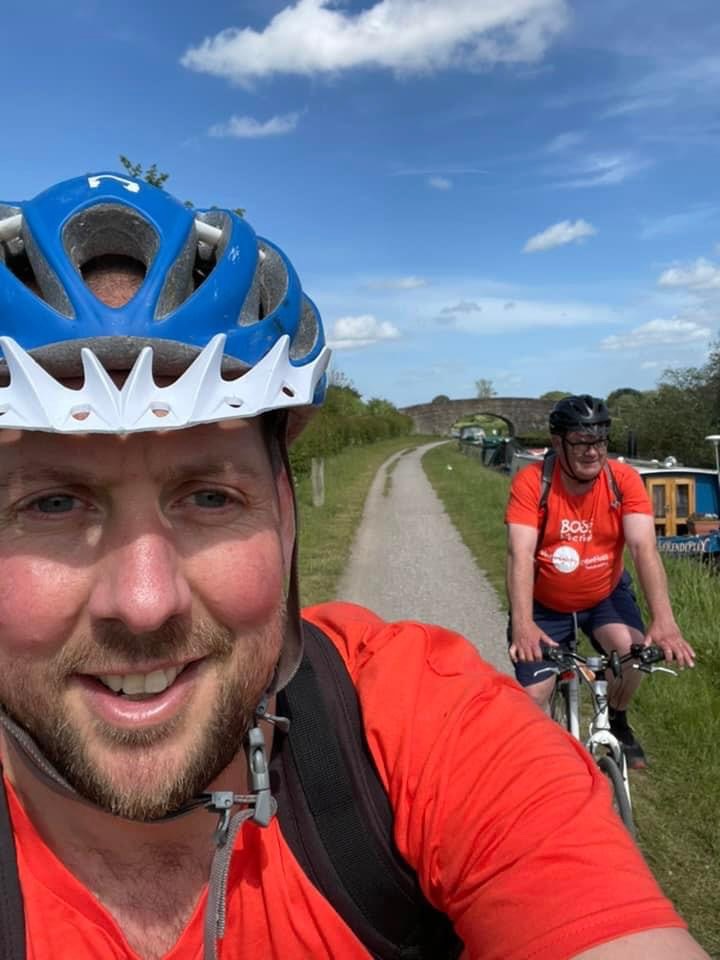
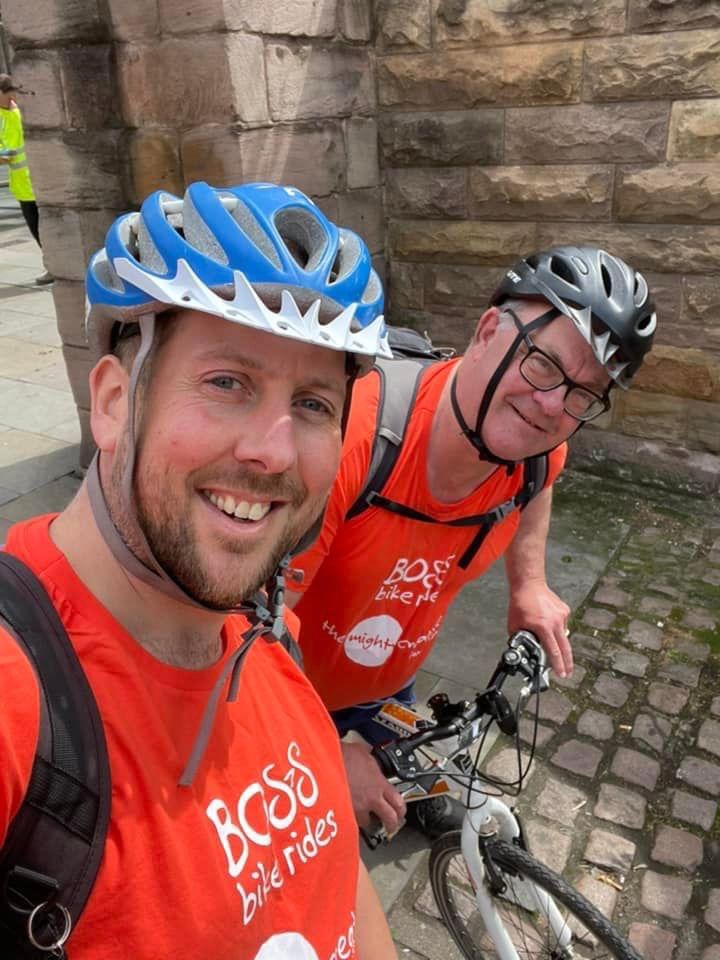
Dan Lamoon from Colab Creation and I set off on our Boss Bike Ride from Nottingham train station in pursuit of some conversations about transitioning: not our own gender re-identification issues on this occasion, but reflections on what identity challenges our respective businesses were facing up to in the months ahead.

Dan was puzzling out about how we transition into a new way of working and how what ‘hybrid working’ really means these days when the novelty of WFH has well and truly worn off and the pleasure of back to back Zoom calls has long since lost its sheen.  What are we now aiming at in this transitioning world we wondered?

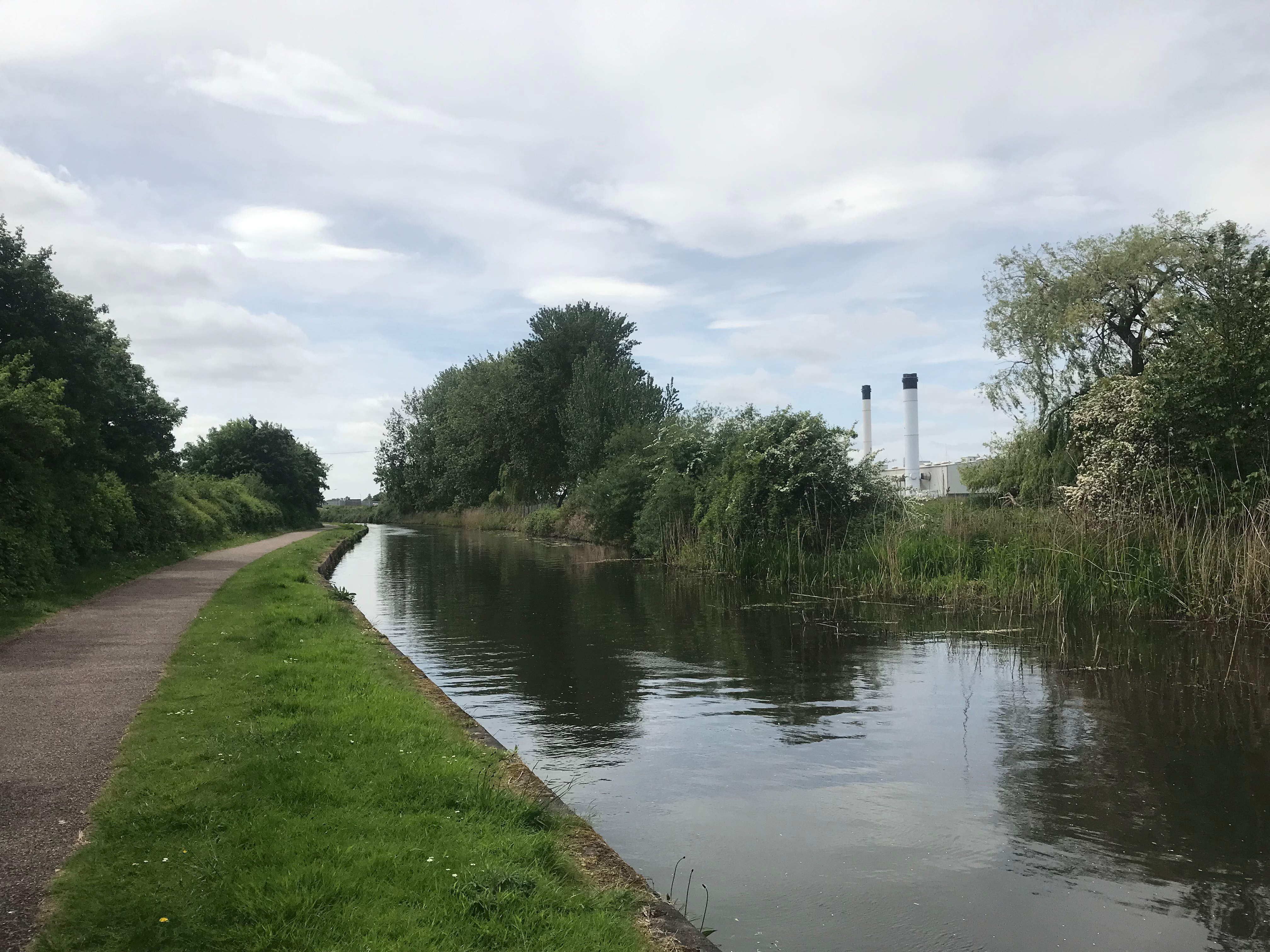
We decided to set ourselves a quite straight froward target for this ride: the cooling towers at Ratcliffe-on-Soar Power Station.  A regional monument to the days when Coal was King, the towers have always offered me a welcome home signal, whenever I’ve travelled back to Nottingham from some distant location.  A few years ago, one of those journeys was marked for ever in my memory by a young girl who remarked to her mum as we passed through East Midlands Parkway, ‘Look mummy, the volcanoes!’  What an evocative, natural world description of power for something so obviously modern and industrial.

Whilst they weren’t smoking on the day Dan and I rode out there, there is something about their elusive behaviour that conjures up a fog of political smoke and mirrors at work.

You’ll experience that elusive behaviour if you ride out to those towers as they show some very strange behaviour en route: one minute they’re directly in front of you, the next they’re on your left, then they’re behind you and before you know it, in front of you again.  

It’s a bit disconcerting and doesn’t help you orientate yourself too easily as you’re riding along.  It’s made worse when you think you’re nearly there, only to see them having shifted way off into the distance again.  And yet whilst you think they’re still miles away, lo and behold, you blink and there they are again.  You’ve inadvertently crept up on them and they’re there in all their volcanic, industrial magnificence.

This elusiveness echoed itself in our chats on the bikes. Whilst we thought we had plotted out some clear transitions and targets for our businesses, in reality these are quite difficult things to navigate at the moment. Many of us are trying to steer a path through the fog of Brexit, Covid, the cost-of-living crisis and the deep fog of the unknown unknowns that the Ukraine-Russia war is generating. One minute you’re looking at your targets face on, the next they’re behind you and then before you know it, they’ve metamorphosed into something completely different.

The cooling towers are supposed to make their own transition to closure by September 2024; but whether their future is also as elusive as their presence remains to be seen. We’re taking bets on whether they’ve seen their last days or whether the current fogginess of the world’s economy might just reconfigure that future and we’ll see them fired up and supplying the region with coal fired power, just one more time.

You can support The Mighty Creatives Boss Bike Ride Campaign here.

Annihilating time and space in Lincolnshire. By Bike.

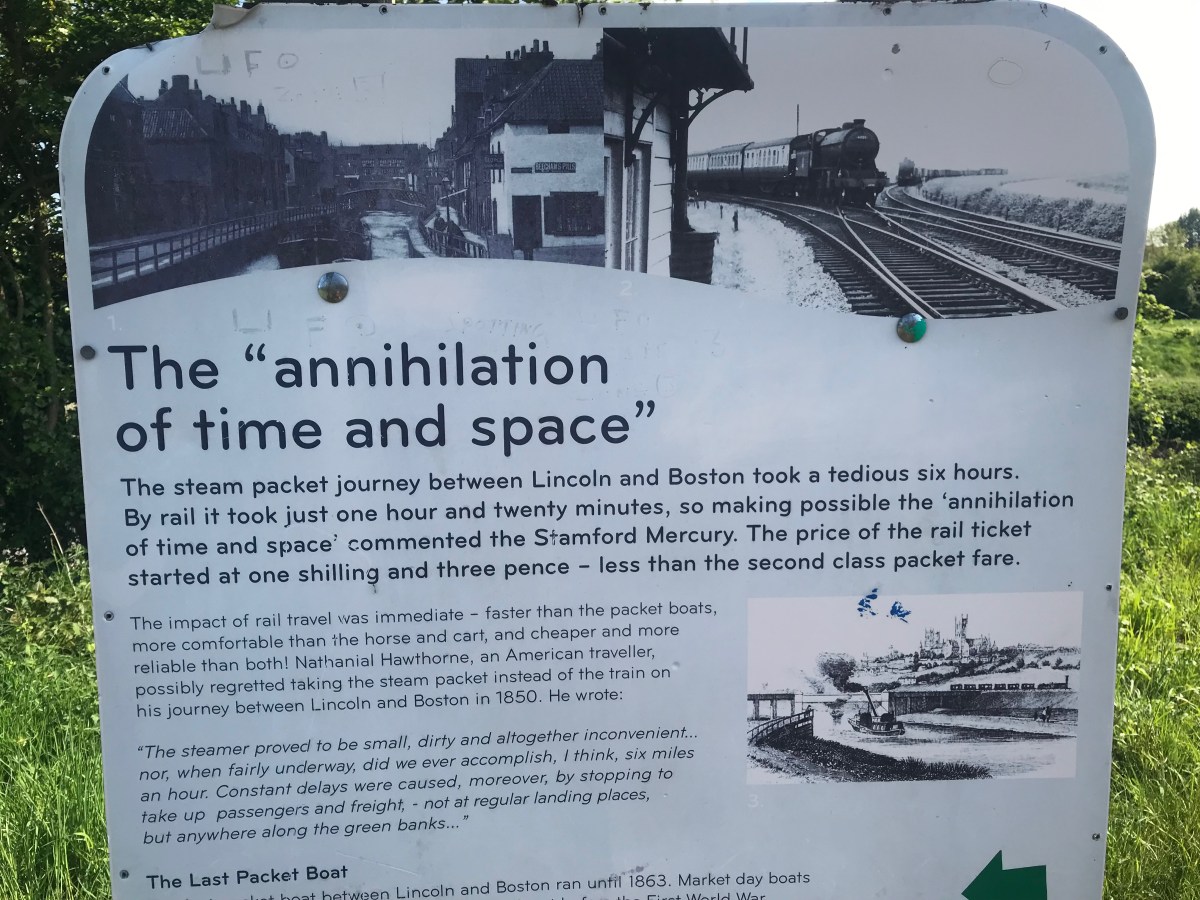
Back in 1850, the Stamford Mercury was so impressed with the impact that train travel was having on the journey from Lincoln to Boston (reducing it from a tedious six hours to just over eighty minutes), it proclaimed in a hyperbolic frenzy that rail travel now made possible the ‘annihilation of time and space’.

Now, we’re quite used to the press stoking up the frenzy on a daily basis in this part of the 21st century so we shouldn’t be too surprised that they were at it in the mid 19th either. What makes this particular brand of hyperbole really interesting though is the fact that the notion of time and space as a ‘thing’ wasn’t really invented until 1908 when the mathematician Hermann Minkowski proposed the space-time continuum as a way to reformulate Albert Einstein’s special theory of relativity.

So, how was it possible for a lowly reporter at the Stamford Mercury to report on the annihilation of a thing that actually wasn’t a thing until 58 years later? Had s/he mysteriously encountered a warp in the time space continuum on the banks of the River Witham which enabled them fall 58 years forward and gain prior knowledge of theoretical physics well before anyone else got a look in? Was train travel that good?

Given the state of the nation’s trains since then, I think this is implausible: but huzzah for the Stamford Mercury and its hyperbole. May it continue until the end of time. Or time-space. Or something like that. We could all do with some time-space annihilation at some point in our lives, and if it takes to riding a bike to experience it, when once only a train would do, then so be it.

I look forward to some time space warp adventures around the shire in the months to come.

More about Boss Bike Rides here.

The Mablethorpe Boss Bike Ride: blowing away the preconceptions of Lincolnshire.

RAF Binbrook and its significance in the Cold War; a 1400 Megawatt high voltage electricity link connecting the electricity transmission systems at Bicker Fen in Lincolnshire, and Revsing in southern Jutland, Denmark, (also known as the Viking Link); and the Alford butchers who make Tomato Sausages for Yorkshire Immigrants. Who knew a pre-supposed isolated county life could conceal so much?

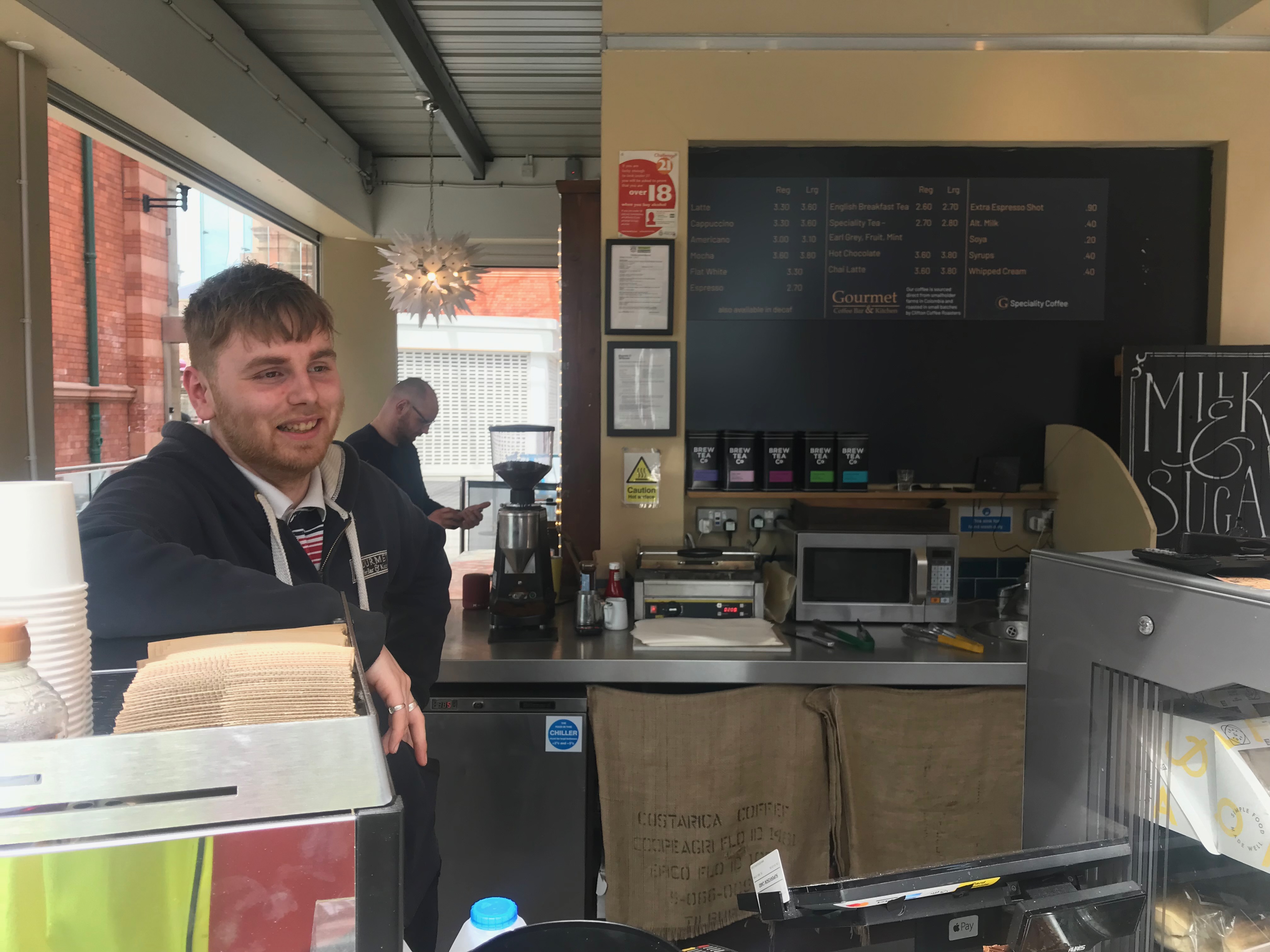
Riding out from Mablethorpe today with Aenaes Richardson from Magna Vitae was a great reminder of Lincolnshire’s significance in the 2nd World War and more latterly on the energy agenda.  Wind turbines are never out of view; the talk of nuclear dumps in Threddlethorpe is literally a hot topic; and cycling across the Viking Way which scars its way across fields and the ocean all the way to Denmark is a startling discovery when all you’re expecting are peaceful country lanes trailing down to the sea and the sky in Sutton on Sea.

But perhaps the biggest reveal of the rural idyll is that, actually, rural doesn’t mean isolation, it doesn’t mean disconnected and it doesn’t mean that it’s separated from the turbulence of economic, cultural and climate changes which are battering our more populated areas around the country. 

On the contrary, the region is in the thick of it as much as anywhere else.

Skegness has been at the forefront of hosting refuges from Afghanistan recently at its seaside Bed and Breakfasts  (only for them to be temporarily shipped to Leicester and back again on account of the poor standard of accommodation but that’s another story); climate emergency planning is expecting to see flooding in the City of Lincoln down at the Brayford Pool  in the not too distant future; and in the meantime we’re planning for large scale industrial expansion and new jobs for young people, and for industries looking for young new leaders.

Whilst Mablethorpe might have one of the biggest static caravan sites in the UK, one thing that isn’t static are the winds of change that are gusting along the roads, down the dykes and across the plains to Denmark and beyond.

If you’re young, want to play hard, work hard and shape your life in Lincolnshire, then now is an exceedingly good time to plan for that vibrant future.  Rural isolation? No chance.

If you’d like to get involved in future Boss Bike Rides, just check us out here.